
Minecraft Cobblestone Generator
Dig a five-block trench with one deeper hole, add water and lava, and mine the cobblestone that forms between them. The plan and both diagrams are right below.
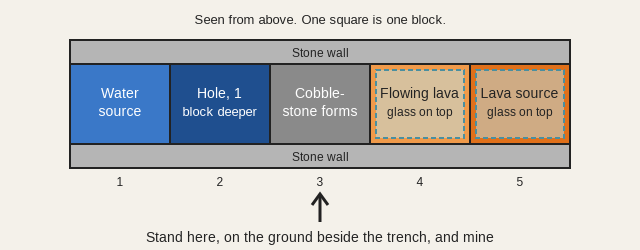
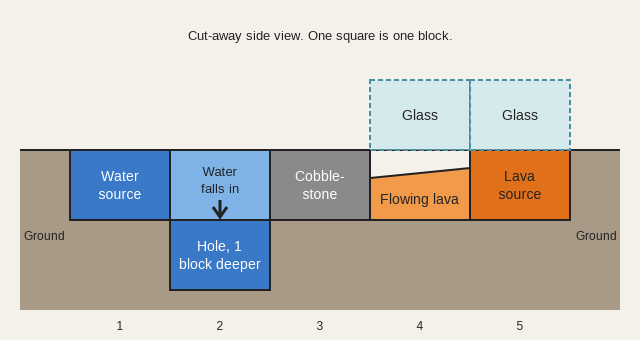
A simple safe build, step by step
This is the five-block trench from the Minecraft Wiki cobblestone farming tutorial. You need one bucket of water, one bucket of lava, a pickaxe, a shovel, and two glass blocks or other fireproof blocks.
- Dig the trench. Dig a straight trench five blocks long and one block deep, with solid stone walls on both sides. Number the spots 1 to 5 in your head.
- Dig the hole. At spot 2, dig one block deeper. This is the hole the water flows into.
- Place the water first. Pour your water at spot 1. It runs into spot 2, falls into the hole and stops. The wiki says to place the water before the lava, or the lava can block the water and no cobblestone forms.
- Place the lava. Pour your lava at spot 5, the far end. This is the lava source. It flows toward the water.
- Watch it form. Where the flowing lava reaches the water at spot 3, a cobblestone block appears. Spot 4 stays as flowing lava.
- Cover the lava. Put glass, or another block that does not burn, on top of spots 4 and 5. Now you cannot fall in, and mined blocks do not land in the lava.
- Mine from the side. Stand on the ground beside spot 3, not in the trench, and mine the cobblestone. Lava flows back in, touches the water, and another block forms.
The water never gets past the hole, so it never touches the lava source. That is the whole trick. It keeps the build from turning your lava into obsidian.
ToolMoth is a fan-made site. It is not affiliated with Mojang or Microsoft, and it uses no Minecraft artwork or logos. The diagrams above are our own drawings.
The rules: cobblestone, stone or obsidian
These rules come from the Minecraft Wiki pages on fluids and lava. The wiki does not split them by edition, so we state them once.
- Cobblestone: Flowing lava that touches water on its side or top turns into cobblestone. If the water is right under the lava, you get stone instead.
- Stone: Lava that flows down into water makes stone. The lava has to sit right above the new block, so stone builds almost always use pistons.
- Obsidian: Water that touches the top or side of a lava source block turns that source into obsidian.
- Basalt: Lava above soul soil and touching blue ice makes basalt. This needs no water.
- The Nether: Water evaporates when placed there, so the usual build does not work.
The one to remember is the obsidian rule. A lava source is a block of lava you placed or found. If water reaches it, you lose the lava. Flowing lava is different and makes cobblestone.
Keep it from burning things
Lava can start fires, from a source or from flowing lava. The area at risk differs by edition. On Java it is the air right above the lava and one layer higher. On Bedrock it is a three by three by three cube around each lava block. In both, wood, wool and similar blocks near the lava are the danger. Build with stone, and keep chests and beds well away.
Cobblestone you mine can also drop into the lava and vanish. The glass over the lava protects the drops. The wiki also suggests a hopper to catch them.
Make a row of cobblestone with a piston
A piston moves each new block out of the way. You still mine the row by hand. Each push makes room, and the lava and water make another block in the same spot. The wiki says a piston can push at most 12 blocks, so one line holds at most 13 cobblestone at a time. That lets you mine a whole row in one go instead of waiting for each block.
This page does not give a piston build plan. The wiki tutorial in the sources shows tested piston designs with their own diagrams. Get the basic trench working first, then add one part at a time.
Common mistakes
- A flat trench with no hole. The water spreads to the lava source and makes obsidian. Dig the hole at spot 2.
- Lava first, water second. The wiki says the lava can stop the water from forming cobblestone. Pour the water first.
- Mining while standing in the trench. Lava is next to you. Stand on the ground beside it.
- Wooden walls. Lava fires burn them. Use stone.
- No cover on the lava. Drops disappear and you can fall in.
- Trying it in the Nether. Water boils away there.
When it stops working
If no block forms, look at the flows. A stray block may be stopping the water or the lava. Check that the water still runs into the hole and that the lava still reaches spot 3. Pick up the lava source with a bucket and place it again, and the build starts fresh. Obsidian is slow to mine and needs a strong pickaxe, so it is easier to avoid making it.
Questions
How do you make a cobblestone generator in Minecraft?
Dig a straight trench five blocks long. Dig one block deeper at the second spot from the water end. Place water at that end so it flows into the hole. Place lava at the far end. Cobblestone forms between them. Mine it from beside the trench and a new block forms in the same spot.
Why does my generator make obsidian?
Water that touches a lava source block turns that source into obsidian. In a flat trench the water spreads all the way to the lava. The deeper hole next to the water source stops that, because the water falls into it and goes no further.
Why is there a hole in the trench?
The hole catches the water. Water flows into the hole and stops, so it never reaches the lava source. Lava flows toward the hole and turns into cobblestone where it touches the water.
How do I get stone instead of cobblestone?
Lava has to flow down into water from above. Stone generators almost always use pistons, because the lava must sit directly over the block being made.
Does a cobblestone generator work in the Nether?
No. Water evaporates when you place it in the Nether, so lava and water cannot meet there.
Can a cobblestone generator burn my items?
Yes. Lava destroys most items that land in it. Netherite items are the exception. Lava can also set nearby flammable blocks on fire. A fireproof block over the lava helps with both.
Facts checked 2026-11-29. Sources: Tutorial: Cobblestone farming, Minecraft Wiki, Cobblestone generator, Minecraft Wiki, Fluid, Minecraft Wiki, Lava, Minecraft Wiki.